25 June 2020

Everyone a marketer


Dear Entrepreneur

Everyone in your organisation is a marketer. And yes, that includes your support staff, i.e. cleaner, driver, etc. Before you look at me askance, wondering how your cleaner could be your marketer, consider the proliferation and growth of the network marketing industry estimated to reach US$160 billion dollars by 2021. No special skills are required for one to become a network marketer- in fact, being a great salesperson is usually an impediment to success in network marketing. People join network marketing from all walks of life, and yes, some of them were cleaners in their previous lives. So, this beckons the question, why are you not leveraging your employees to market your company?

Marketing is concerned with attracting customers, building relationships, communicating service/product benefits in a bid to influence perceptions. While the marketing department can and is capable of handling these tasks, one notes that building relationships is not solely the preserve of the marketing department. If anything, the marketing department’s interaction with customers is limited when compared to interactions the whole organization has with customers. So, does it not make sense then to turn everyone in an organization into a marketer, albeit, a part-time one.

If we look closely at our own interactions with companies we buy from, we will note that we have progressed from first time buyers to advocates because of the product elements and also the service quality we receive when dealing with the company. For most of us, our interactions with the marketing department personnel are limited, if not non-existent. We deal with the operations teams, the sales teams, the delivery guys, finance teams, receptionists and sometimes when we visit- the cleaners. It is these interactions that determine whether we buy from a company; deepen our relationship with them and/or even refer them to our own network. It behoves you, therefore, to ensure that every client interaction with your company adds shows your company in a positive light. Does it therefore not make sense to make every staff member a de facto marketer?

Network marketing’s success is premised on turning everyone who joins them into a marketer. The business runs on repeat business because the industry provides the requisite training to their recruits (most of them at least do), and the previously unskilled workers thrive. This, therefore, means that to turn your organisation into a mean marketing organisation training on customer service, client relationships, service quality etc is paramount. A receptionist who disrespects a client will cost you revenue, a driver who is rude to a client will cost you business, and likewise, an accountant who fails to provide a client with a refund on time will cost you business. Is it therefore not worth it to arm your staff with requisite skills to turn them into a marketer?

How many of you have all your staff as marketers? How did you manage to get everyone to rise up to the challenge?

27 May 2020

Growing your business

'I thought running a business would be hard to start but would get better over time. We've increased our revenue, hired more people, ..., so why am I overwhelmed?' Does this resonate with you as an entrepreneur? This is a common refrain from entrepreneurs wondering how turning their idea into an exciting venture resulted in them wanting to pull out their hair in frustration and working all hours to resolve issues.

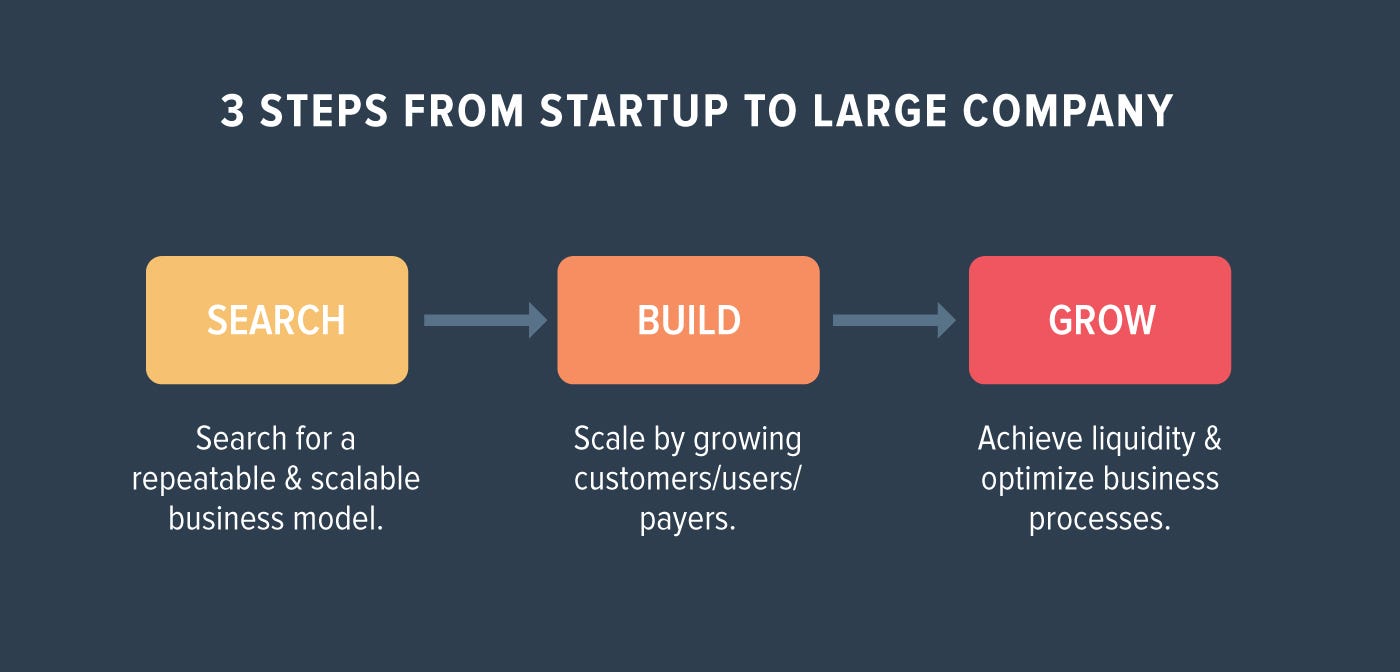
According to Steve Blank (the father of modern entrepreneurship), there are 3 stages from startup to a large company:
Steve Blank

50% of startups fail within 5 years of inception

If your business is at this stage- the search stage- you beat the odds stacked up against you! Most startups fail here because they lack a good product/market fit, have cash flow issues, etc. You will, however, note that your organisation is agile- pivoting in response to changes in the environment- risk-taking; has few processes and does whatever it takes to get the work done. You run on adrenaline!

71% of businesses fail to make it past year 10

In this period, startups move from search to build stages, and while the reasons for failure at this stage are varied, startups tend to grow beyond the capacity of the founder to handle every aspect of the business. Also, their sources of competitive advantage in the search stage i.e. overly customised product/service, founders involvement in everyday tasks, whatever it takes mentality and one centre of power, become their Achilles heel when they progress to the build stage. 

Systems and processes

To succeed in the build stage, installation of systems and processes in a startup is vital. Systems and processes allow one to (1) understand clearly how their business operates, (2) tease out the important processes from the unimportant ones, (3) offer a consistent product/service, (4) focus on idea generation and (5) take time off work confident in the knowledge that the business will continue to run in their absence, Yay! 

If you are ready to enjoy running your business again, here are a few simple steps to instituting systems and processes in your organisation:

1. Analyse your transformation process 
Determine what your inputs are, how you source them, how you transform them into your final product, etc. Ask yourself which of the steps you are taking are working, what's not, how long does it take to move from input to output and what you would change? 

2. Evaluate your processes
Analyse your processes and (1) determine their efficacy in achieving your end goal, (2) get rid of processes that add no value to your transformation process (3) reduce the time it takes to complete a process, (4) reduce the number of people needed to complete a process and (5) identify where in the process value is created and whether that value accrues to the customer or the business.

3. Create process maps
These help you identify all the necessary steps in your transformation process and ensure that each process feeds seamlessly into the next. Starting with the desired outcome and working backwards will help in highlighting the necessary processes. When done, compare this to your current processes, look for the most efficient steps and eliminate any unnecessary ones. Write down the process; that way, everyone in the organisation has access to it and can implement it. 

4. Test your process
The only way to find out if your process makes sense is to test it and tweak it where the results are not as desired. While testing your process, also decide on which steps in your process can be automated and automate them.

5. Test-run with your employees
This goes without saying. Since your employees are at the forefront of delivering to your clients, train them on how to use the set process map and encourage them to adhere to it to avoid variances in outputs. 

6. Systems improvement
A system is a living thing and, therefore, should be adjusted in light of new information. Staff should feel free to suggest changes to the processes.

Note:

1. There is no need to wait until you are in the build stage of your business to implement systems and processes. They can be implemented as soon as you work out your product/service delivery process. 

2. The move from search, build, grow is not linear and there are no hard and fast rules about how long a business spends at any of these stages. It very much depends on the nature of the business. 

What systems/processes do you have in your business? When did you implement them? If you do not have any, consider looking at implementing them and get in touch if you need help navigating the process.

12 May 2020

Taking businesses online

Covid-19 has come and upended the way we have been doing business. Talk to any business owner and the conversation will veer towards taking their businesses online. The global lockdown has had business owners rethinking their marketing channels and so it is not surprising that almost everyone whose business can be moved online is looking to do so.  Those still holding out on taking your businesses online because your business has not been affected by covid-19, know that you are missing out on an important constituent for your business that is online and should make plans to engage them.

But, before one thinks of taking their business online one should come up with a digital marketing strategy, and in this article, we will look at some of the issues you as an entrepreneur should consider.

1. Target market & segmentation

It is vital that you have a clear understanding of whom your target market is. To do so, you should be able to clearly break them down by demographics, geography and psychographic elements. You will also need to understand your customer buying process, i.e. how long it takes them to move from need awareness to purchase. Once you are clear on whom your target market is, you will find reaching them becomes easier and cost-effective.

2. Channel

Tied to the target market is knowing where your target market congregations online. When you sold your wares in a shop, you relied on footfall for your clients, with an online business, you have to be clear on where your target market spends its time or searches for your products. Here you could be thinking of using a website to drive sales, online shop like Shopify, e-Bay, Amazon, FB, etc or you could use social media, mobile apps to reach your target market. However, given the many social media platforms available there is a need to decide on which of these you will use- FB, Pinterest, Instagram, LinkedIn, etc.

When thinking of the channel(s) to use and how to use them, consider what purpose that channel will fulfil. Are you using the channel for informational purposes where you share content? If you are, how engaging will your content be? Or is the purpose to convert your leads into sales? Also, consider whether you would like your channel to be interactive and how responsive will you be?

3. Reach

Determine how you are going to reach your target market. Will you do so organically or use paid ads? If you plan to use paid ads, do you have a budget for this and what outcomes would you consider as successful utilisation of your budget? If using organic growth what activities are you going to engage in that will allow you to reach your target market at the level you want? Who will be responsible for engaging with your followers- you or a hired social media manager?

4. Goals and expected outcomes

Set SMART goals that are aligned to your business objectives. This will guide your actions and ensure that you focus only on activities that lead to your expected outcomes. Once your goals and expected outcomes are set out, you will want to track your performance, so you need to decide on which metrics to measure e.g number of followers, the number of shares, engagement, post reach, mentions, conversion rate, click-through rate, bounce rate, testimonials, etc, There are many metrics out there that you could use but focus only on the ones that help to meet your marketing objectives and by extension your business objectives.

5. Payment systems

For some businesses, the payment systems they used while offline will be redundant while operating online, so it is important to device payment systems that will suit your online clients. The beauty of living in 2020, covid-19 excepting, is that there are myriad of ways that payments can be made, so select the ones that are convenient to both you and your customers from mobile money, to Paypal to stripe, credit cards, etc.

6. Returns

Selling products brings its own challenges with regards to the inability of customers to try on a product (clothes, shoes, etc) before buying and the same is true for services too. To counter this problem, some service providers offer free trial periods during which time a client decides whether or not the service meets their needs before they splash money on it. So, determine how you are going to deal with clients wanting to return products they had purchased. How you handle this will in part determine your customer's satisfaction with your service.


6. Listen to your followers

Finally, the most important point I would live you with when operating online is to listen to your customers. Client feedback has never been more important and easy to get than now. Act on their concerns.

Let me know what other strategies you would add or subtract to these in your online business.


24 April 2020

How to stay productive while working from home.

Covid-19 has seen a change in the way we work. For most of us, working from home is our new reality, and it is only fair that if you are new to it, or you love the hustle and bustle of an office, you would find it daunting. In this blog, I will share some insights on how to stay productive while working from home from both an employer's and employee's perspective.

Employer's perspective

As an employer, you need to consider the following issues when you ask your employees to work from home and ensure that they can be productive:

Security
Ensure that you have policies on data security in place to regulate remote work.
Are your internal systems accessible remotely or are they password or secure key protected? How are your staff going to access your company intranet while working remotely?

Communication
Be clear- clarity and brevity are key
Minimise your communication. Only send messages when necessary, do not inundate your staff with messages.
Have rules on communicating and set expectations e.g.  when to call vs when to message,  response times to messages & emails, etc.
To compensate for lack of physical contact, use video to communicate with team members. This allows you to address any concerns much better than with other forms of communication

Alignment
Be clear on deliverables- set weekly targets, KPIs
Be clear on delivery timeframes
Depending on your workflows, smooth the handover/takeover process especially between departments.
Have meetings at least once a week on video with your team.

Relationships
Touch base with your subordinates. Find out what challenges they are having working remotely, their productivity, morale, etc
Exhibit emotional intelligence- show empathy

Execution
If you can, use productivity tools like Asana, Slack, etc which details who is responsible for what and ensures that all the information is easily shareable and staff can collaborate easily on tasks
Google suite allows you to collaborate and edit documents live
Implement systems and process that are followed religiously to avoid a breakdown in work
Where possible, allow your staff to determine the time they work instead of rigidly sticking to an 8-5pm workday.

Capacity
Provide staff with the tools they will need to carry out their tasks if working remotely eg laptops, wifi/internet bundles, airtime, etc.
Train them on how to use productivity tools- slack, zoom, etc
Make remote working fun and less lonely- take breaks and ‘meet by the water cooler’ for a chat

 Employees perspective

 With the employer having provided all that an employee needs to do their work, it now falls on the employee to be productive. As an employee, consider the following issues when working from home:

The right frame of mind
Get up knowing you are going to work even if that work is to be conducted from your home
Feeling demotivated- talk to your manager
Start work on time

Conducive environment
Where possible, create a home office that detaches you from the home activities allowing you to concentrate on your work.
Wherever you choose to work from, make sure it is comfortable as you will be sitting there for +/- 8 hours.
Set ground rules with your household and stick to them. Let them know when you are busy, when they can approach you, when they should not approach you, etc.

Be deliberate
Be clear on what you want to achieve- refer to your weekly targets, KPIs
Create a to-do list: this will help you stay focused on the work you need to do
Seek help when you are stuck. Do not let a problem fester

Time management and prioritisation
Now that you know what needs to be done, prioritise your work and handle the most important tasks first.
Time yourself- this gives you an idea of how many hours you are actually working and whether or not you are using your time efficiently. I use Toggle for this, and I am currently trialling Time Doctor.
Build-in flexibility into your work. Remember your workmates, clients, family, etc will require your time too during the course of the day. You cannot ignore their requests.
Come up with a clear plan on when you will respond to emails and messages from colleagues so that you are not distracted from your core work. If your company has set guidelines on this, follow the guidelines.

Collaborate
You are working from home, but not working alone. Collaborate with others
Assist those in need and ask for help when in need

Socialise
Participate in virtual co-working to recreate what you would do when in an office
Do drop by the ‘water cooler’ and chat with colleagues
While being social, be respectful of other people’s desire to not engage in non-work related banter
Set clear boundaries- Depending on your company’s agreed on forms of communicating be clear when you are available to chat, when you do not want to be disturbed, etc.

End of the working day
End on time
Switch off all work gadgets.
Go spend time with your family, exercise, walk, etc

I wish you all the best with the new normal way of working!

17 March 2020

Business Processes- Start-ups and SMEs


Without a doubt, successful businesses the world over have managed to remove/limit complexity in their organisations. One way of doing so is by designing processes that take away guesswork in the way a task is performed. So, that means that regardless of who handles a task, the way it’s done, the quality and speed of execution will always be the same. Take for example your favourite bakery; every time you visit it to get your favourite cake slice, the cake tastes the same, and that is precisely why you keep frequenting the bakery. None of us ever asks which pastry chef is on duty; we just rest in the comfort of knowing that the next day we come for that cake slice, it will taste just as good as it did today. The reason the quality is the same is that such bakeries have laid down processes that everyone follows to the letter, ensuring a consistent product.

Because businesses are complex machines, there are many parts to them, aka departments, it follows, therefore, that each department should have its own processes, so in the end a company has a plethora of processes, i.e. accounting processes, operations processes, sales processes, etc. Remember, the reason for coming up with processes is to limit complexity and make companies agile, but if a company is going to end up with a plethora of processes, is that not introducing complexity and drag in the organisation?

A global company I once worked for was big on processes, which helped streamline our work. Unfortunately for us, these departmental processes were developed in isolation of other departments. So instead of simplifying our work, they ended up adding layers of complexity to the way we did business. You would find a process in sales would clash with a process in operations, which in turn clashed with processes in accounting. We were constantly frustrated at the ‘other’ department(s) whose ‘inflexibility’ made it difficult for us to achieve our goals, and at the same time, we were failing to meet our customer expectations as an organisation. It was only after we sat down as a company and aligned our departmental processes that we started to pull in the same direction, and offer the great service we had promised our clients, which translated into increased revenues.

As a business, do you have well laid out processes or do you rely on the presence of some individual who seems to have a knack for doing a certain task? In your organisation, how do you design your departmental processes? Is it a collaborative effort between departments or each department develops its processes in isolation of other departments? Let’s chat!

2 March 2020

Business in the midst of epidemics for start-ups and SMEs.


How many businesses out there have ever included disease outbreaks on their business risk assessments? Up until recently, and all thanks to 
Covid-19, disease outbreaks were not an issue I considered a risk that needed mitigating by a business. But given the way world markets are tumbling in the wake of Covid-19, is it not time that businesses took epidemics as a potentially serious threat to their businesses? Read the newspapers these days and you will read of Toyota keeping its factory in China shut and how that will impact their revenues, Primark with 40% of its goods coming out of China trying to find alternative source markets or Apple with its Iphones assembled in China having to delay production and launch of their new smartphones, which will indubitably have a negative impact on their revenues. These are all big companies; they can weather the storm, but what of start-ups and SMEs, how are they currently faring, and how will they fare in the future if disease outbreaks, as predicted by WHO become prevalent?

An e-commerce start-up that I am rooting for and am quite bullish about has found itself at the mercy of Covid-19. They have China as their sole source market, and so for the first two months of this year, they have had depressed sales because until recently, nothing was coming out of China. The founders of this business are bootstrapping, and cannot afford even a day of closed Chinese borders unlike your Apple, Toyota, et al. We all know how fickle clients are; there are only so many apologies and explanations you can give to your buyers for why their goods are stuck in China- even if the reasons are beyond your control, as is the case with Covid-19- before they switch their patronage to your competitors, who have diversified source markets.
 If the Covid-19 epidemic is not contained soon, it will bankrupt many a start-up and SMEs with high exposure to China. It’s time businesses took another look at their business models and re-did their business risk assessments taking into account disease outbreaks and how they could mitigate them.

How is your organisation affected by Covid-19? What steps have you taken in your organisation to mitigate its impact? Going forward, what strategies do you have in place to combat another epidemic? Drop your comments in the comments section and let’s discuss.

25 February 2020

Website content


So, recently, a client asked me to listen to a brainstorming session they had had and tease out information they could use as content on their website. Prior to this day, I had never paid any attention to content creation but had experienced it as a consumer on websites I visit. Some content I found helpful, others not so much, and others even frustrating.

This got me thinking: what makes for good content on a website? So I did a bit of research, and came across content strategy. This means that the content should assist an organisation to achieve its long term goals. It's not just about coming up with content for the sake of content, or so that people can say you have a website! The content purpose is twofold: 1. to meet business objectives and 2. to meet user expectations.


 Elements of Content Strategy

According to the foremost thought leaders in content strategy, CEO and founder of Brain Traffic Kistrina Halvorson, and co-founder of Dialog Studios Melissa Rach, content strategy comprises content components as well as people components, but I will focus on the content components here, specifically content substance, i.e. what messages does content need to communicate to our audience?

But what is good content? Without getting too academic, according to some gurus in this area- Chakraboty et al (2015), there are 3 dimensions to content which are:
1    1. Informativeness- the ability of a web site to make information available,
2    2. Usability of information- users perceived ability to utilise content i.e. reduces consumers’      search costs by helping to access the information available on a website more efficiently
3  3. Quality of information- the quality of the content in a website and the suitability of the content from a user’s perspective.

So good content should meet these dimensions. Getting this information was an aha! moment for me. It shed light on why I enjoyed visiting some websites and found some very frustrating. It had all to do with the purpose the content on those websites was meant to fulfil, and whether the content met the 3 dimensions of content. The ones I hated failed to meet my expectations which are generally to find useful actionable information.

I don't know about you, but I hate company websites that sell products but do not display the prices of those goods, and instead invite you to contact them for a price!!! Like, what the hell! If I wanted to call you and ask for a price, I would not have wasted my time browsing your website. These websites rank poorly on the usability of information. Inevitably, this leads to very poor user experience. Depending on the product they are selling, they could lose a potential buyer to a competitor whose prices are easily accessible. I was looking to buy a car recently and found the Toyota website content usability on point. It reduced my search costs by ensuring that the information I needed, in this case, car prices, was easily accessible. Its competitors, on the other hand, required that I call them for a price, which I did begrudgingly as I need to find a car within my budget.

I also hate websites whose content is not properly laid out. Have you been on a website where you keep scrolling down and new information keeps appearing and there seems to be no end to the stream of information, yet you still cannot find what you are looking for? It’s almost as if you are reading a 100-page word document but on a webpage! That is a poor quality layout of the webpage. One wonders why such information could not be curated into various pages on the website.

Anyway, a seemingly simple task got me researching content strategy and what makes for good content and marrying it to my own experiences with content. What has been your experience with the content on websites? If you have a website, did you follow any particular strategy in creating that content and does the content meet the 3 content dimensions? Which of the content purposes does your content fulfil? I would love to know your experiences with website content. Drop your responses in the comment section and let’s have a discussion on content creation.

Cheers
Angella